
Disputes
How chargebacks work and how to respond to them.
A dispute (also called a chargeback) is when a customer asks their bank to reverse a payment instead of asking you for a refund. The bank takes the money back, and you get a chance to prove the charge was valid.
As the Merchant of Record, Pandabase handles the dispute with the card network and passes it to you so you can respond.
You have 7 days to send your evidence once a dispute opens. We'll email you when a dispute is filed.
Lifecycle
Opened
The order moves to Chargeback. The disputed amount plus a $20.00 dispute fee is held from your balance until it's resolved.
Evidence
You submit your evidence from the dashboard within 7 days. We pass it on to the card network for you.
Under review
The customer's bank reviews the evidence. This usually takes 30 to 75 days.
Resolved
You win — the disputed amount comes back and the order returns to Completed. The $20 dispute fee is not refunded. You lose — the money stays with the customer.
Reasons
| Reason | What it means |
|---|---|
| Fraudulent | The cardholder claims they didn't authorize the charge. |
| Product not received | Customer says they never got what they paid for. |
| Product unacceptable | Received but doesn't match the description. |
| Subscription cancelled | Customer says they cancelled but were billed anyway. |
| Duplicate | Customer believes they were charged twice. |
| Credit not processed | You promised a refund and the customer never received it. |
| General | No specific reason given by the issuing bank. |
Fees
| Outcome | Effect |
|---|---|
| Dispute opened | Disputed amount + $20.00 fee deducted from your available balance. |
| Won | Disputed amount restored to your balance. The $20.00 dispute fee is not refunded. |
| Lost | Deduction stands. The $20.00 dispute fee and the original processing and platform fees are not refunded. |
| Prevented | Disputed amount + $30.00 prevention fee deducted. Terminal, doesn't affect your rate. See Prevented disputes. |
Dispute rate
Your dispute rate is the share of your payments that get disputed, measured over the last 3 months. Keep it below 0.75%.
If it stays above 0.75%, we'll contact you and review new payments more closely. Card networks can restrict or stop card payments if the rate remains high. You can check your current rate on the Analytics page.
Respond
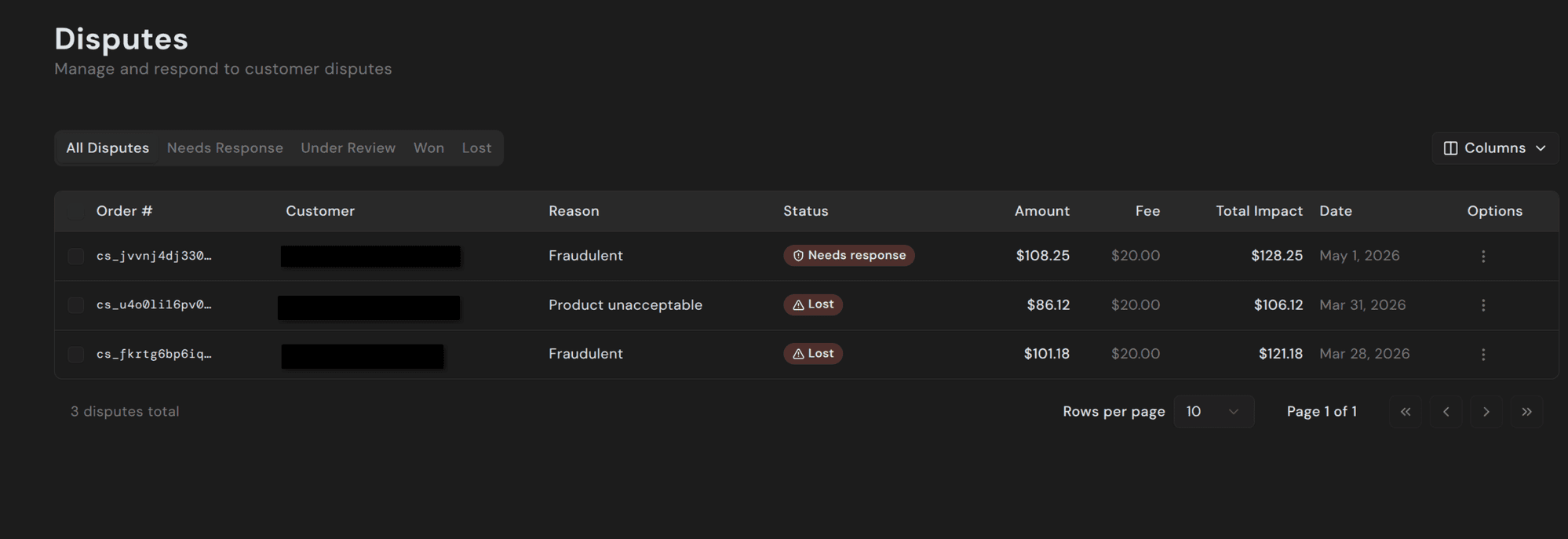
Open the disputed order from the Disputes page. The detail view shows the dispute reason, disputed amount, dispute fee, total impact on your balance, the original order items, customer info, and the full payment timeline.
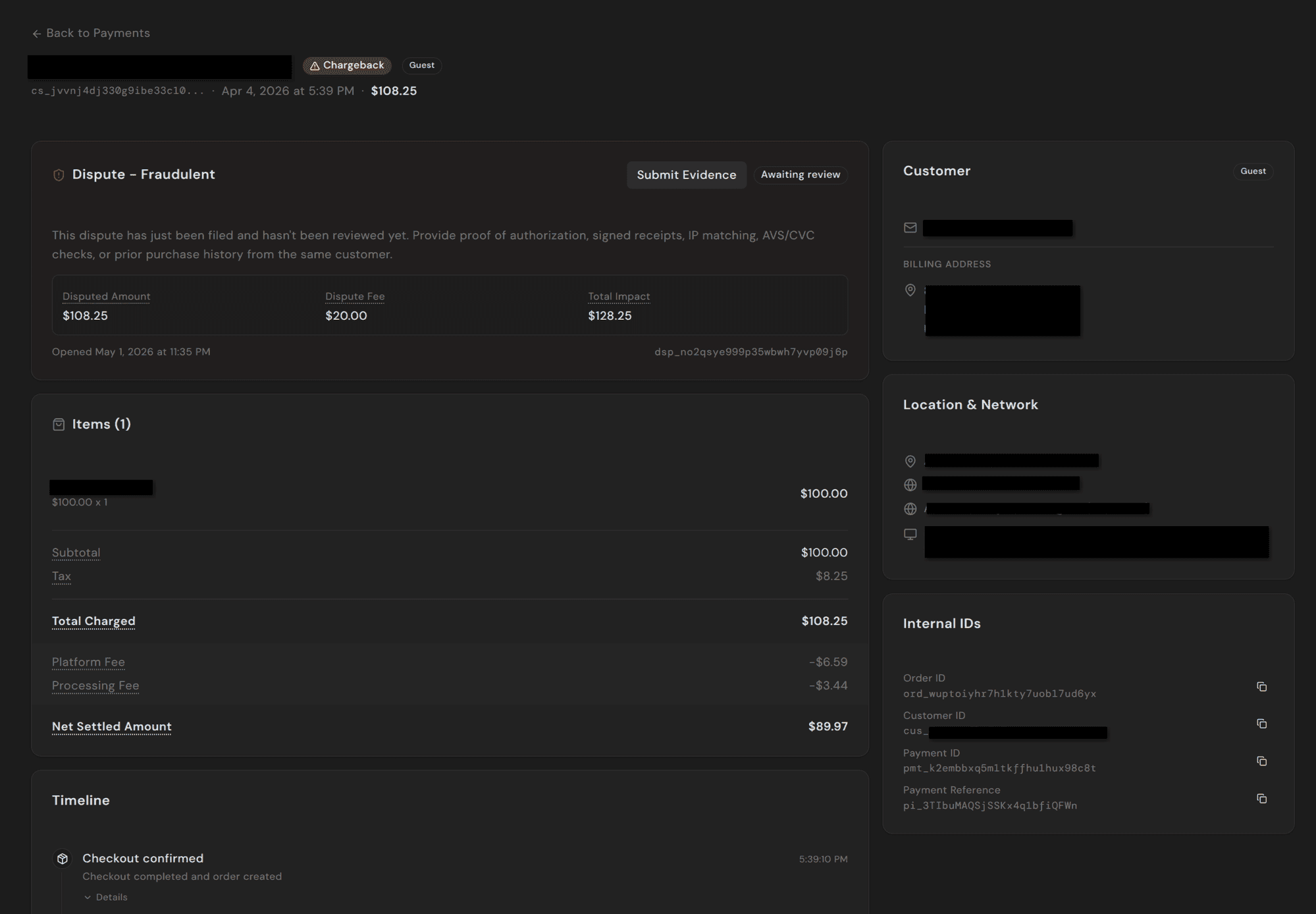
Click Submit Evidence to open the response form.
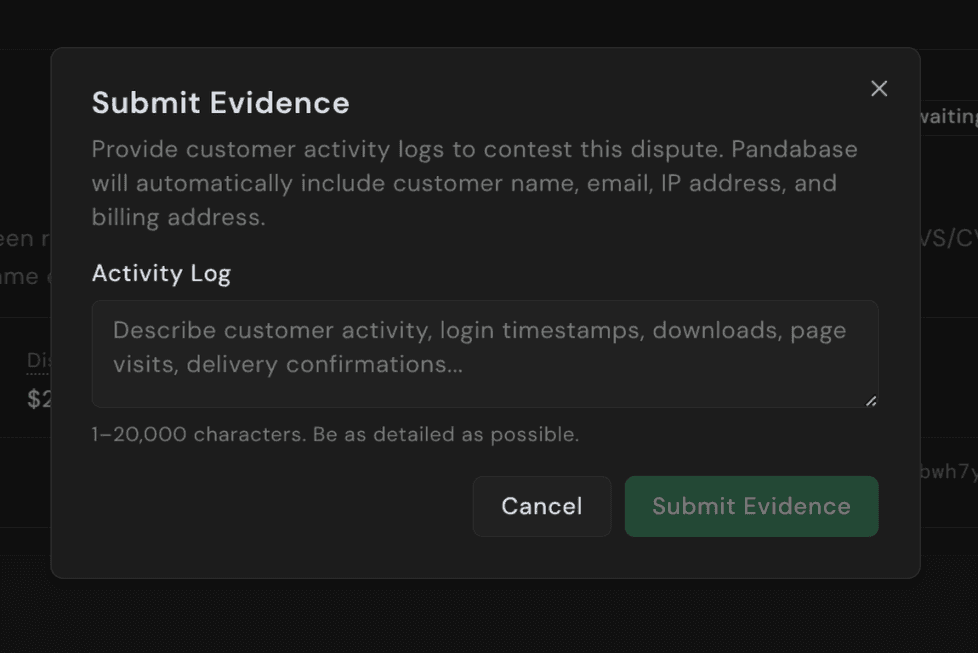
Pandabase automatically includes the customer's name, email, IP address, and billing address in the evidence package. You provide the Activity Log — a written description of how the customer used what they paid for. Up to 20,000 characters. Be specific:
- Login timestamps, session durations, IP addresses they accessed your platform from
- Downloads, license activations, API calls, content viewed
- Delivery confirmations, support tickets, emails or chats with the customer
- For "product unacceptable", what was delivered and how it matched the description
- For "subscription cancelled", proof of continued usage after the alleged cancellation date
You can submit evidence once. Gather everything before submitting.
Accepting a dispute
To accept a dispute, leave it without submitting evidence. There is no "Accept" button. After 7 days, the chargeback is finalized and the disputed amount and fee remain deducted.
Prevention
Pandabase prevents most disputes before they reach you. All of the following run automatically — there's nothing to configure.
Always-on 3D Secure
Every card payment is authenticated with 3D Secure 2 at checkout. If the cardholder can't authenticate, the transaction is rejected.
Successful 3DS shifts liability for fraud disputes from you to the issuing bank in nearly every region we operate.
Order Insight & Consumer Clarity
When a cardholder questions a charge with their bank, the bank receives order details (product, merchant name, billing address, fulfillment info) directly from Pandabase. Most "I don't recognize this charge" disputes resolve here.
Early Fraud Warnings
Sometimes the card network tells us a payment is likely to be disputed before the chargeback is actually filed. These warnings are free — there's no fee to receive one.
- Orders ≤ $50 — refunded automatically. No impact on your dispute rate, fulfillment revoked.
- Orders > $50 — you decide whether to refund pre-emptively or contest. We email you with the EFW reason.
Acting on an EFW keeps the chargeback off your dispute rate entirely — which is what matters most once you're approaching the 0.75% threshold.
Prevented disputes
If a chargeback is filed without an earlier EFW, Verifi's Rapid Dispute Resolution (RDR) and Ethoca Alerts can still catch it and resolve it with the issuing bank before it becomes a formal dispute. The cardholder is refunded by the network.
Unlike an EFW, you don't get a chance to contest — the network intercepts after the dispute is filed. The disputed amount plus a $30 prevention fee is deducted from your balance, the order moves to Chargeback, and the dispute appears with status Prevented.
Prevented disputes require no evidence and have no won or lost outcome. They have no impact on your dispute rate or VDMP/ECM ratio.
Compelling Evidence 3.0
For fraud-coded disputes, Pandabase automatically submits a CE 3.0 package when the data supports it. CE 3.0 lets merchants defeat fraud disputes by proving a prior good relationship — we look for two or more prior undisputed transactions from the same cardholder with matching IP, device fingerprint, billing address, or customer account.
CE 3.0 has a high win rate but doesn't apply to every dispute. Disputes where the network confirms the card was used without authorization will be lost regardless of any evidence submitted.
What you can do
- Use a clear store name and product descriptions. Most "fraudulent" disputes are customers not recognizing the charge.
- Make refunds easy. Most disputes start because the customer couldn't get a response from you.
- Send fulfillment confirmations promptly — receipt and access details in the same email.